Introduction
Australia is moving rapidly toward a cleaner and more sustainable transport future—and electric vehicles (EVs) are leading this shift. To encourage more drivers to transition from petrol to electric, federal and state governments across Australia have introduced multiple incentives, rebates, and tax concessions.
This guide provides a complete overview of Australia’s EV incentives and rebates for 2025, helping buyers understand eligibility, savings, and the latest policy changes. Whether you’re upgrading to your first EV or exploring a business fleet transition, this guide gives you the financial insights you need.
Why EV Incentives Matter
Electric vehicles offer several benefits, including lower emissions, reduced running costs, and quieter performance. However, the upfront purchase price of an EV can be higher than that of a traditional petrol vehicle. To make EVs more accessible, governments offer incentives designed to:
-
Make EVs affordable for individuals and families
-
Support Australia’s shift to low-emission transport
-
Encourage EV infrastructure growth
-
Reduce long-term environmental impact
As EV adoption continues to increase, incentives may evolve, phase out, or shift toward infrastructure investment. Below is the full breakdown of what’s available in 2025.
National (Federal) EV Incentives in Australia
The Australian Government provides several national-level incentives aimed at reducing tax obligations and making EV ownership more cost-effective.
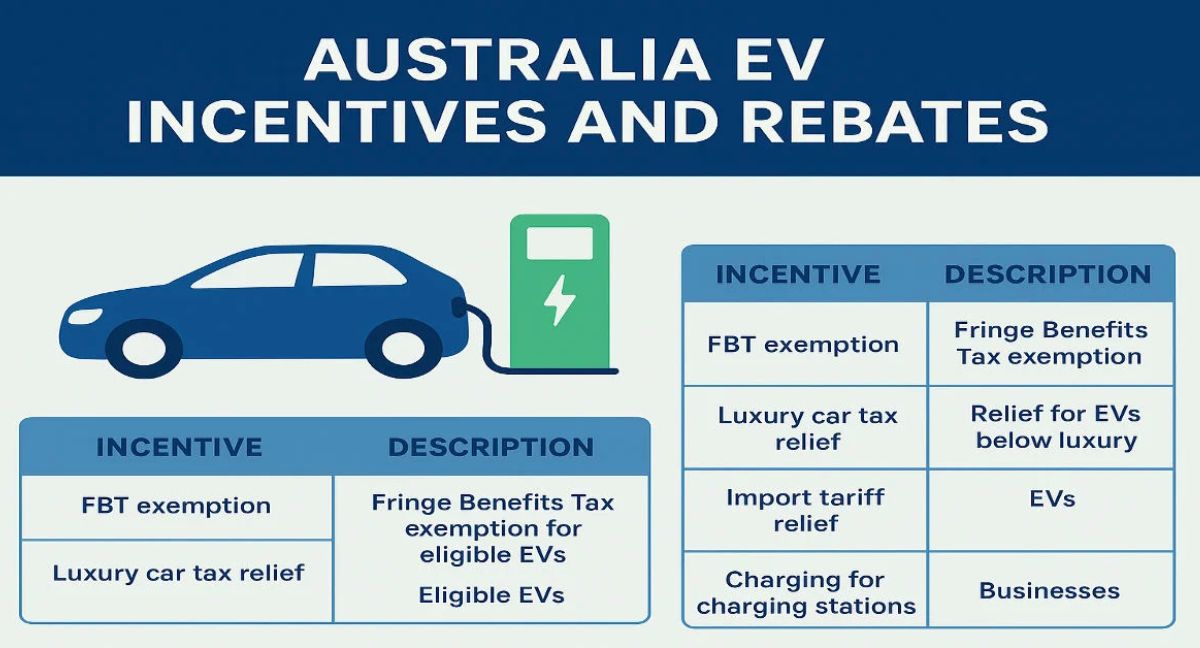
1. Electric Car Discount (Fringe Benefits Tax Exemption)
One of the strongest incentives is the FBT exemption for eligible EVs used under salary-sacrifice arrangements, such as novated leasing.
Table: FBT Exemption Summary
| Incentive | Details | Eligibility |
|---|---|---|
| Fringe Benefits Tax (FBT) Exemption | Removes FBT on approved EVs below the Luxury Car Tax threshold (~$89,332). | Applies to new BEVs and hydrogen fuel-cell vehicles used for salary-sacrifice or employer fleets. |
This exemption can reduce the overall cost of ownership by 20–40%, making EV leasing highly attractive for employees.
2. Import Tariff & Luxury Car Tax Relief
Premium EVs that meet fuel-efficiency standards may qualify for import tariff reductions or full LCT relief.
Table: LCT Relief Overview
| Program | Description | Vehicle Requirement |
|---|---|---|
| LCT Relief for Fuel-Efficient Vehicles | Removes luxury car tax on qualifying EVs. | EVs or hybrids priced under $89,332 with low emissions. |
This helps keep popular models—such as Tesla Model 3, BYD Seal, and Hyundai Ioniq 6—competitively priced.
3. National Charging Infrastructure Programs
These programs support the installation of fast chargers across Australia.
| Program | Focus | Who Benefits |
|---|---|---|
| Driving the Nation Fund | $500 million to develop highway charging corridors and regional stations. | Charging operators, councils, transport hubs. |
| Future Fuels Program (ARENA) | Supports workplace and fleet charging solutions. | Businesses, government fleets, commercial sites. |
While not direct rebates, these programs improve EV practicality for long-distance and rural drivers.
State and Territory EV Incentives and Rebates (2025)
EV incentives differ across Australian states and territories. Some have active rebates, while others offer registration discounts or charger support.
Table: 2025 State-by-State EV Incentives
| State/Territory | Incentives Offered | Notes |
|---|---|---|
| ACT | No stamp duty, up to 2 years free rego, interest-free loans up to $15,000. | Most generous 2025 incentives; targeting 90% EV sales by 2030. |
| NSW | Rebates ended; ongoing registration concessions. | Incentives reduced after 2024 reforms. |
| QLD | $6,000 rebate ended; reduced rego and duty fees remain. | Temporary rebate closed Sept 2024. |
| VIC | ZEV subsidy ended; discounted rego continues. | Rebates discontinued mid-2023. |
| SA | 3-year registration exemption for EVs under $68,750 (until June 2025). | Past rebates closed. |
| WA | $3,500 rebate ended May 2025; charging infrastructure support continues. | Infrastructure focus moving forward. |
| TAS | Rebates ended; interest-free loans available for chargers. | Emphasis on green finance. |
| NT | $1,500 duty concession, up to 5 years free rego, $1,000 charger grant. | Strong ongoing support through 2027. |
Comparing Savings Across States
To understand the value of incentives, here is a comparison for a new EV priced at $65,000.
Table: Estimated Savings on a $65,000 EV
| State | Estimated Savings | Approx. Final Cost |
|---|---|---|
| ACT | $4,000–$6,000 | ~$59,000 |
| SA | $1,500–$2,500 | ~$62,500 |
| NT | $2,500–$3,000 | ~$62,000 |
| NSW | Limited savings | ~$63,000 |
| QLD | Minor rego savings | ~$63,000 |
| VIC | Registration only | ~$63,500 |
| TAS | Loan-based benefit | ~$64,000 |
| WA | Rebate ended | ~$64,000 |
Top savings in 2025: ACT and Northern Territory.
Incentives for Businesses and Fleets
Business and fleet operators benefit significantly from national programs:
-
FBT exemption for qualifying EVs
-
Lower charging and maintenance costs
-
Grant access for fleet infrastructure
-
Potential accelerated depreciation
EV salary-sacrifice arrangements (novated leases) have become especially popular among companies aiming to cut fleet emissions.
EV Home Charging Support
Some states provide financial assistance or loans for home charger installations.
Table: Home Charger Support by State
| State | Support | Description |
|---|---|---|
| ACT | Interest-free loans | Covers EVs or chargers up to $15,000. |
| NT | $1,000 grant | Reimbursed after installation. |
| NSW/VIC/QLD | Limited to commercial programs | No direct home charger incentives. |
Installing a home charger typically costs $1,000–$2,500, making interest-free loan options helpful for first-time EV owners.
How to Apply for EV Incentives
Follow these steps when applying for rebates or concessions:
-
Check eligibility for your vehicle and price threshold.
-
Purchase from an approved dealer with compliant paperwork.
-
Apply online via the relevant state service portal.
-
Submit required documentation such as registration, purchase invoice, and ID.
-
Receive rebate or credit, usually within 6–8 weeks.
Always verify application deadlines, as some benefits close quickly.
Future of EV Incentives in Australia
As EV adoption grows, government priorities are shifting. Expect changes such as:
-
Expanded national charging corridors
-
More corporate fleet electrification
-
Potential future EV road-user charges
-
Growth in battery-recycling and sustainability programs
-
National targets guiding EV adoption by 2030
Experts predict EV price parity with petrol cars by 2027, even without rebates.
Economic and Environmental Impact
EV incentives have accelerated adoption across the country. According to industry data:
-
EVs reached nearly 10% of new car sales in 2024
-
More affordable models, like BYD Dolphin and MG4, increased market access
-
Reduced emissions support Australia’s net-zero 2050 goals
Cleaner transport improves air quality and reduces national fuel dependence.
Tips to Maximize EV Savings
-
Choose a model under the LCT threshold
-
Apply early—rebates often close suddenly
-
Use salary-sacrifice leasing for tax benefits
-
Install a home charger for cheaper energy costs
-
Use off-peak electricity tariffs
-
Monitor government websites for updated policies
Frequently Asked Questions (FAQs)
1. Are used EVs eligible for incentives?
Some previous programs included used EVs, but in 2025 most active incentives focus on new vehicles.
2. Can I receive both state and federal incentives?
Yes—federal tax exemptions can be combined with state-level registration or charger incentives.
3. Do plug-in hybrids qualify?
Most incentives prioritise battery-electric vehicles (BEVs); PHEV eligibility is limited.
4. What if I move states after buying my EV?
Your rebate applies to the state where the vehicle was first registered.
5. Do businesses receive different benefits?
Yes, including FBT exemption, potential fleet grants, and depreciation advantages.
Conclusion
Australia’s EV incentives in 2025 continue to support the switch to cleaner, more efficient vehicles. Although several cash rebates have ended across major states, benefits such as FBT exemptions, registration discounts, charger grants, and infrastructure programs still provide valuable savings.
For the best financial advantage, the ACT, Northern Territory, and South Australia offer the strongest remaining incentives in 2025. As EV prices fall and charging networks expand, electric vehicles will become even more accessible for Australian households and businesses.
If you’re planning to buy an EV, check your state’s eligibility rules and take advantage of available incentives before programs change or close.
1 thought on “Australia EV Incentives and Rebates”