Introduction
As electric vehicles continue gaining momentum across the United States, safety has become one of the top concerns for American drivers. Beyond range, performance, and charging convenience, EV buyers want to know: Are electric vehicles truly safe?
The answer lies in EV Safety Crash Tests USA, conducted through rigorous standards and advanced engineering techniques. Organizations like the National Highway Traffic Safety Administration (NHTSA) and the Insurance Institute for Highway Safety (IIHS) ensure that electric cars meet strict federal safety guidelines—often pushing safety innovation even further.
This guide explores how EV crash tests work, what they measure, and which electric vehicles rank among the safest in the nation.
Understanding EV Safety Standards in the USA
Electric vehicles follow the same federal crash test rules as gasoline-powered cars but undergo additional tests related to battery safety, electrical stability, and post-crash fire prevention.
Regulatory Bodies Conducting EV Safety Tests
| Agency | Full Form | Main Focus |
|---|---|---|
| NHTSA | National Highway Traffic Safety Administration | 5-Star Safety Ratings, crashworthiness, rollover resistance |
| IIHS | Insurance Institute for Highway Safety | Frontal, side, roof strength tests; Top Safety Pick titles |
These agencies evaluate how well EVs protect passengers, pedestrians, and emergency responders in real accident scenarios.
How Crash Tests Are Conducted for Electric Vehicles
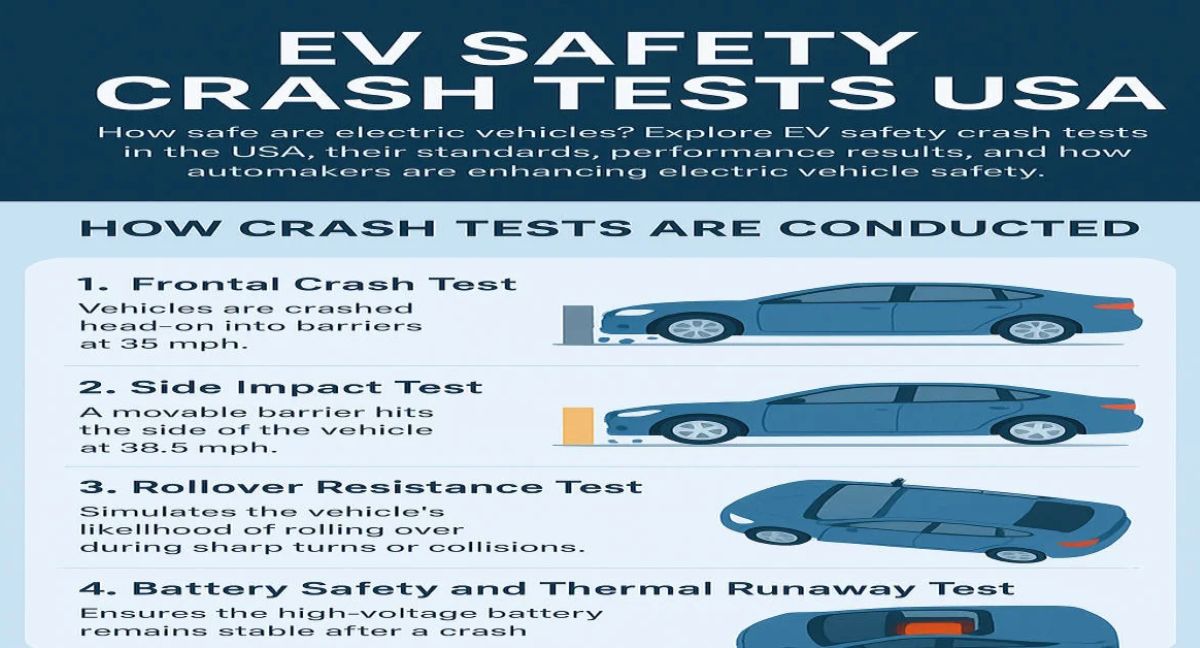
EV crash testing replicates real-world crashes using controlled lab setups. The key areas include:
1. Frontal Crash Test
-
Conducted at 35 mph into a fixed barrier
-
Measures airbag efficiency, cabin structure, and dummy injury levels
-
Evaluates both adult and child passenger protection
2. Side Impact Test
-
Performed using a movable barrier at 38.5 mph
-
Determines impact severity on front and rear passengers
3. Rollover Resistance Test
-
Measures a vehicle’s likelihood of rolling during sharp turns
-
Important for electric SUVs and crossovers
4. Battery Safety & Thermal Runaway Test
-
Ensures batteries remain stable after a crash
-
Checks for short circuits, leakage, and fire hazards
5. Electric Shock Protection
-
Confirms automatic shutdown of high-voltage systems
-
Ensures occupants and first responders are shielded from electrical shock
Why Battery Safety Matters Most
The lithium-ion battery is the core component of an EV—and one of its biggest safety priorities. Testing ensures batteries resist damage, overheating, and fire risks.
Key Battery Safety Tests
| Battery Safety Test | Purpose |
|---|---|
| Crush Test | Ensures battery casing withstands heavy force |
| Penetration Test | Tests resistance to sharp objects during impact |
| Thermal Shock Test | Measures performance in extreme temperature variation |
| Overcharge Test | Ensures battery system prevents overcharging |
| Fire Resistance Test | Checks fire spread control and thermal stability |
Manufacturers like Tesla, Rivian, and Lucid have introduced advanced cooling systems and reinforced battery enclosures to enhance protection.
Top-Rated EVs in USA Crash Tests
Several EVs consistently score high in both NHTSA and IIHS safety ratings.
Top EV Safety Performers
| EV Model | NHTSA Rating (Out of 5) | IIHS Rating | Key Safety Features |
|---|---|---|---|
| Tesla Model Y | 5 | Top Safety Pick+ | Rigid structure, autopilot safety, advanced impact protection |
| Rivian R1T | 5 | Top Safety Pick+ | Heavy-duty frame, reinforced battery, adaptive restraints |
| Hyundai Ioniq 5 | 5 | Top Safety Pick+ | Collision avoidance, lane-centering, safe exit assist |
| Ford Mustang Mach-E | 5 | Top Safety Pick | Rollover stability, pedestrian alerts, assisted braking |
| Volkswagen ID.4 | 5 | Top Safety Pick | High-strength chassis, multi-collision braking |
These vehicles combine strong crash performance with intelligent safety technologies.
Crashworthiness vs. Post-Crash Safety
Crashworthiness focuses on protecting passengers during the collision. Post-crash safety addresses what happens after the impact, including:
-
Automatic battery disconnect
-
Fire suppression systems
-
Emergency responder access
-
Battery containment systems
For example, Tesla integrates cell firewalls and coolant loops to prevent thermal spread during accidents.
EVs vs. Gas-Powered Cars: Safety Comparison
Studies from both NHTSA and IIHS show EVs often perform better than traditional gasoline vehicles due to their structural design and lower center of gravity.
Performance Comparison
| Safety Parameter | Electric Vehicles (EVs) | Gasoline Vehicles (ICE) |
|---|---|---|
| Frontal Crash Performance | Excellent stability | Moderate to strong |
| Side Impact Protection | Strong (battery frame support) | Varies by model |
| Rollover Resistance | Very low | Higher due to fuel tank placement |
| Fire Risk | Extremely low | Moderate due to fuel flammability |
EVs generally have a sturdier build, enhancing passenger protection.
Innovations Enhancing EV Safety
Manufacturers are introducing new technologies to improve EV crash performance:
1. Advanced Driver Assistance Systems (ADAS)
-
Automatic braking
-
Blind-spot monitoring
-
Lane keeping assist
2. V2X Communication
EVs communicate with infrastructure, pedestrians, and nearby cars to prevent crashes.
3. Reinforced Battery Enclosures
Strong aluminum or composite casings protect batteries during side impacts.
4. AI-Powered Safety Systems
AI analyzes driver behavior and road conditions in real time.
How EV Manufacturers Meet US Crash Standards
All EVs sold in the United States must meet Federal Motor Vehicle Safety Standards (FMVSS). Some brands lead the industry with enhanced testing protocols.
Leading EV Brands in Safety Testing
| Brand | Safety Highlights |
|---|---|
| Tesla | Over-the-air updates improve vehicle safety ratings |
| Rivian | Uses aluminum armor for battery protection |
| Ford | Mach-E uses predictive crash algorithms |
| Hyundai | Uses ultra-high-strength steel in EV platforms |
EV Crash Tests & Fire Safety Concerns
Public fears around EV battery fires are common, but data shows EVs are 60% less likely to catch fire compared to fuel vehicles.
Fire Safety Enhancements
-
Multi-layer battery insulation
-
Automatic high-voltage shutoff
-
Fire-retardant battery modules
-
Improved cooling systems
These updates ensure EV fires remain extremely rare.
Real-Life Crash Test Insights (2025 Update)
Recent crash test reports highlight impressive advancements:
-
Tesla Model Y retained cabin stability in high-speed frontal crashes
-
Rivian R1S showed strong protection in side-impact assessments
-
Hyundai Ioniq 6 excelled in pedestrian safety tests
These results reinforce that EVs are becoming some of the safest vehicles in the U.S. market.
Future of EV Crash Testing in the USA
The next stage of EV crash testing will include:
-
AI-driven virtual crash simulations
-
Cybersecurity safety tests
-
Autonomous driving accident modeling
-
Battery recycling safety assessments
Regulators like NHTSA and IIHS are continually updating protocols to ensure EV safety keeps improving.
Conclusion
EV Safety Crash Tests USA highlight the dedication of manufacturers and regulators to ensuring electric vehicles are as safe—or safer—than traditional vehicles. With robust battery protection, advanced driver assistance technologies, and high crash-test scores, EVs are redefining what safety means on American roads.
From the Tesla Model Y’s structural strength to the Hyundai Ioniq 5’s intelligent safety features, today’s electric vehicles prove that the future of safe transportation is not only electric—it’s exceptionally secure.
1 thought on “Ensuring the Future of Electric Mobility is Safe”